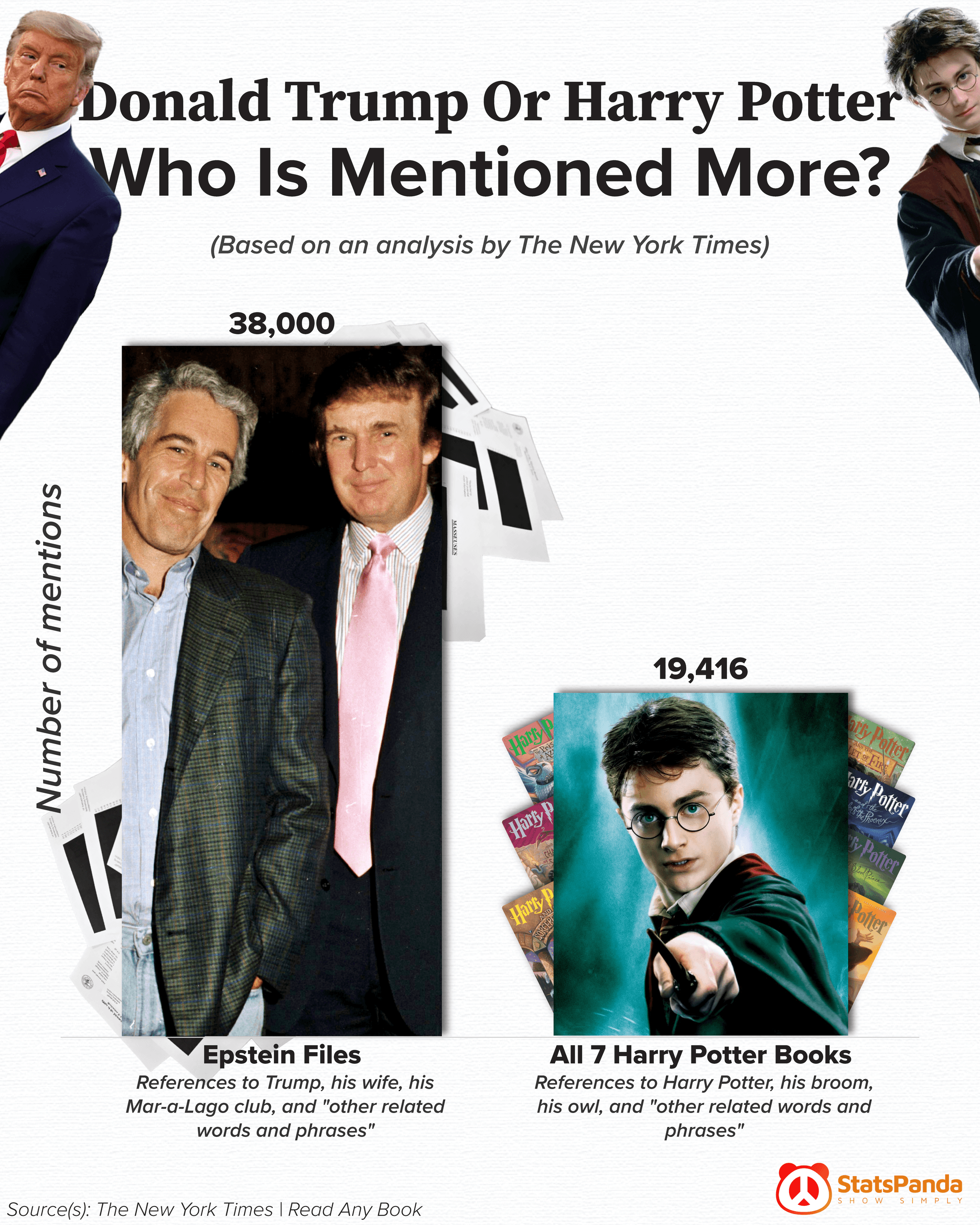
Donald Trump is referenced 38,000+ times across 3.5 million pages of Epstein files — nearly double the 19,416 times Harry Potter is mentioned in the entire book series.
The Data
In February 2026, The New York Times published an analysis of the newly released Jeffrey Epstein investigation files using a proprietary search tool. Their count revealed that Donald Trump — along with references to his wife, his Mar-a-Lago club, and other related words and phrases — appears over 38,000 times across roughly 3.5 million pages of documents.
For comparison, a computational text analysis of all seven Harry Potter novels — searching for "Harry Potter, his broom, his owl, and other related words and phrases" — turns up 19,416 references across 3,623 pages. That means Trump is mentioned nearly twice as often in investigative documents as the protagonist of one of the best-selling book series in history is mentioned in his own story.
| Subject | Document Collection | Mentions | Total Pages | Mentions per Page |
|---|---|---|---|---|
| Donald Trump | Epstein Investigation Files | 38,000+ | ~3,500,000 | 0.01 |
| Harry Potter | All 7 Harry Potter Books | 19,416 | 3,623 | 5.36 |
The Per-Page Frequency Tells a Different Story
Raw mention counts are only half the picture. The Epstein files span approximately 3.5 million pages. When you calculate mentions per page, Harry Potter appears at a rate of 5.36 per page — compared to Trump's 0.01 per page. That's a per-page frequency ratio of roughly 494 to 1 in Harry Potter's favor.
This makes intuitive sense: Harry Potter is the central character of a tightly focused narrative, mentioned on nearly every page. Trump's 38,000 mentions are distributed across millions of pages of legal filings, FBI tips, and news clippings — the majority of which don't reference him at all.
What's Actually in the Epstein Files?
Not all mentions are equal. The New York Times noted that many Trump references in the Epstein files come from news clippings Epstein collected, FBI tips from the public, and third-party emails discussing Trump — rather than solely from direct investigative documents.
Documented evidence from the files includes:
| Evidence Type | Detail |
|---|---|
| Flight Logs | 8 logs showing Trump as a passenger (1993–1996) |
| Social Connection | Photographs from a documented 15-year relationship (1987–early 2000s) |
| Contact Book | 14+ phone numbers listed in Epstein's contacts |
| Private Emails | Emails from Epstein discussing Trump |
Counting Methodology
To ensure a fair parallel comparison, both searches used the same approach: the primary name plus associated people, places, and possessions.
| Search Category | Trump Search Terms | Harry Potter Search Terms |
|---|---|---|
| Primary Name | Donald Trump | Harry Potter |
| Associated People | Melania Trump | Hedwig (owl) |
| Associated Places/Objects | Mar-a-Lago | Firebolt, Nimbus 2000 (broomsticks) |
Analysis
Volume vs. density. The raw numbers favor Trump by nearly 2:1, but the per-page density massively favors Harry Potter at 494:1. This is a reminder that raw mention counts without context can be misleading — the scale of the source material matters enormously.
Context of mentions matters. A reference in a novel is intentional narrative craft. A reference in investigative files could be a newspaper clipping, a third-party tip, or an actual investigative document. Treating all mentions as equivalent obscures the nature of each document collection.
Why this comparison is striking. Despite the density difference, the sheer fact that one real person appears 38,000 times in investigative files — nearly double the references to a fictional character in his own story — illustrates the extraordinary scale of the Epstein investigation and the breadth of Trump's connections within it.
Methodology
Trump mention data comes from The New York Times' February 2026 analysis of the released Epstein investigation files, using their proprietary search tool. Harry Potter mention data comes from computational text analysis of the complete seven-book series. Both searches included the primary name plus associated people, places, and possessions to ensure parallel counting approaches.
Sources
- The New York Times
- Read Any Book