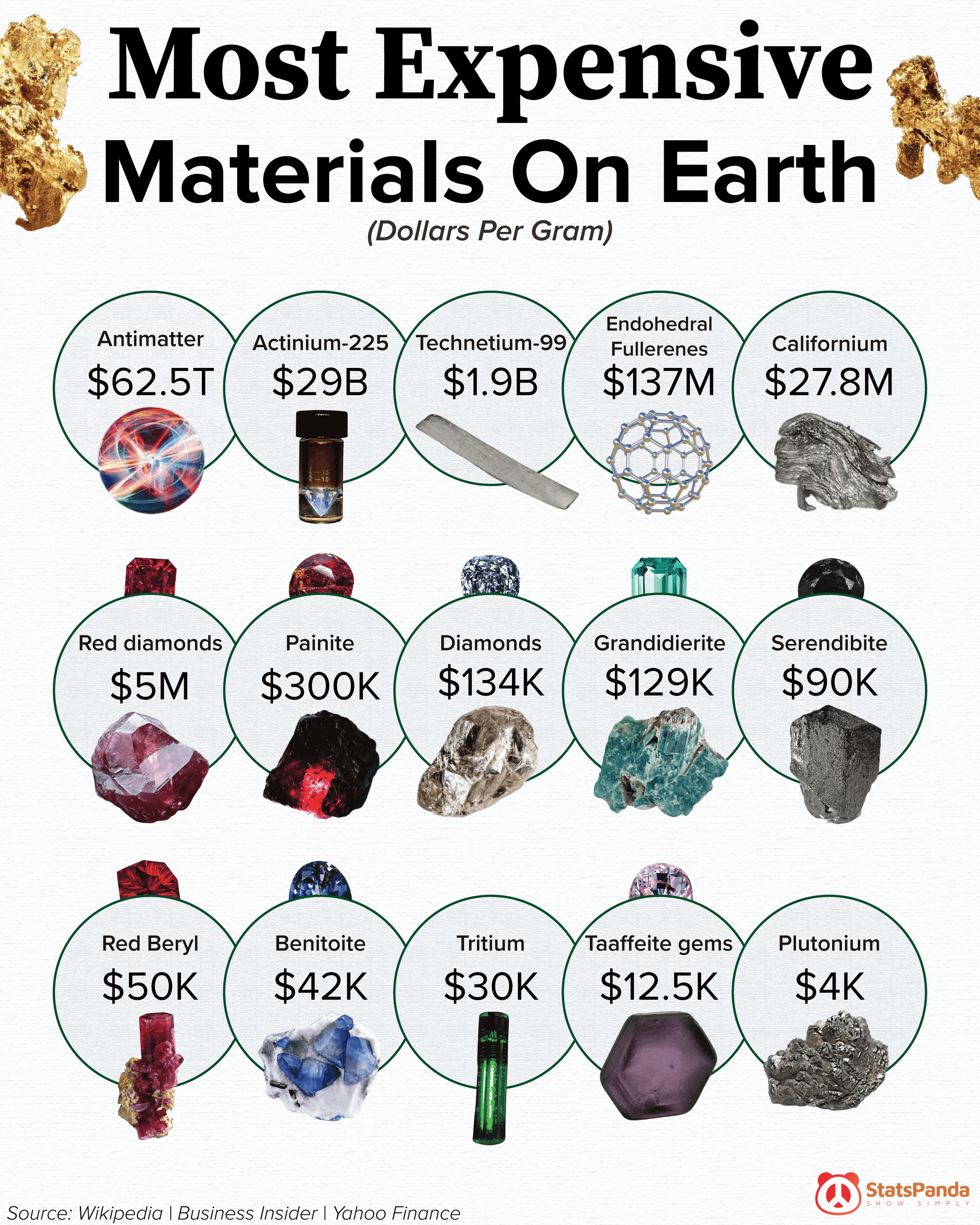
Antimatter costs an astronomical $62.5 trillion per gram—more than the GDP of most countries combined. From medical isotopes to precious metals, here are the rarest materials on the planet.
The Data
When we think of valuable materials, gold and diamonds come to mind. But the truly expensive substances on Earth exist at the intersection of physics, medicine, and extreme rarity. Some materials cost more per gram than entire economies produce in a year.
| Rank | Material | Price Per Gram | Primary Use |
|---|---|---|---|
| 1 | Antimatter | $62.5 Trillion | Research |
| 2 | Actinium-225 | $29 Billion | Cancer Treatment |
| 3 | Californium-252 | $27 Million | Nuclear Research |
| 4 | Carbon-14 | $3.2 Million | Dating/Research |
| 5 | Tritium | $30,000 | Self-Illumination |
| 6 | Painite | $9,000 | Gemstones |
| 7 | Plutonium | $4,000 | Nuclear Power |
| 8 | Taaffeite | $2,500 | Gemstones |
| 9 | Rhodium | $200 | Catalytic Converters |
| 10 | Gold | $65 | Jewelry/Investment |
Analysis
Antimatter is impossibly expensive. At $62.5 trillion per gram, antimatter costs more than the combined GDP of the United States, China, and the European Union. CERN produces only nanograms per year, and each particle annihilates upon contact with regular matter, making storage essentially impossible. It exists primarily as a research curiosity.
Medical isotopes are the practical rarities. Actinium-225, used in targeted alpha therapy for cancer treatment, costs $29 billion per gram because it can only be produced in nuclear reactors in tiny quantities. Global production is measured in milligrams per year, yet demand is growing as cancer treatments become more sophisticated.
Gold is relatively cheap. At "just" $65 per gram, gold—humanity's traditional store of value—ranks near the bottom of truly expensive materials. Its accessibility relative to radioactive isotopes explains why civilizations have used it as currency for millennia.
Price Scale in Perspective
- 1 gram of Antimatter would cost more than the entire US federal budget
- 1 gram of Actinium-225 could fund a small country for a year
- 1 gram of Gold costs about the same as a nice dinner
The million-fold differences between materials on this list demonstrate the vast range of economic value that substances can hold—from common precious metals to substances that challenge the boundaries of physics to produce.
Methodology
Prices compiled from scientific literature, market data, and industry reports. Radioactive material prices reflect research/production costs. Precious metal prices based on market rates. Antimatter price is a theoretical calculation based on CERN's estimated production costs.