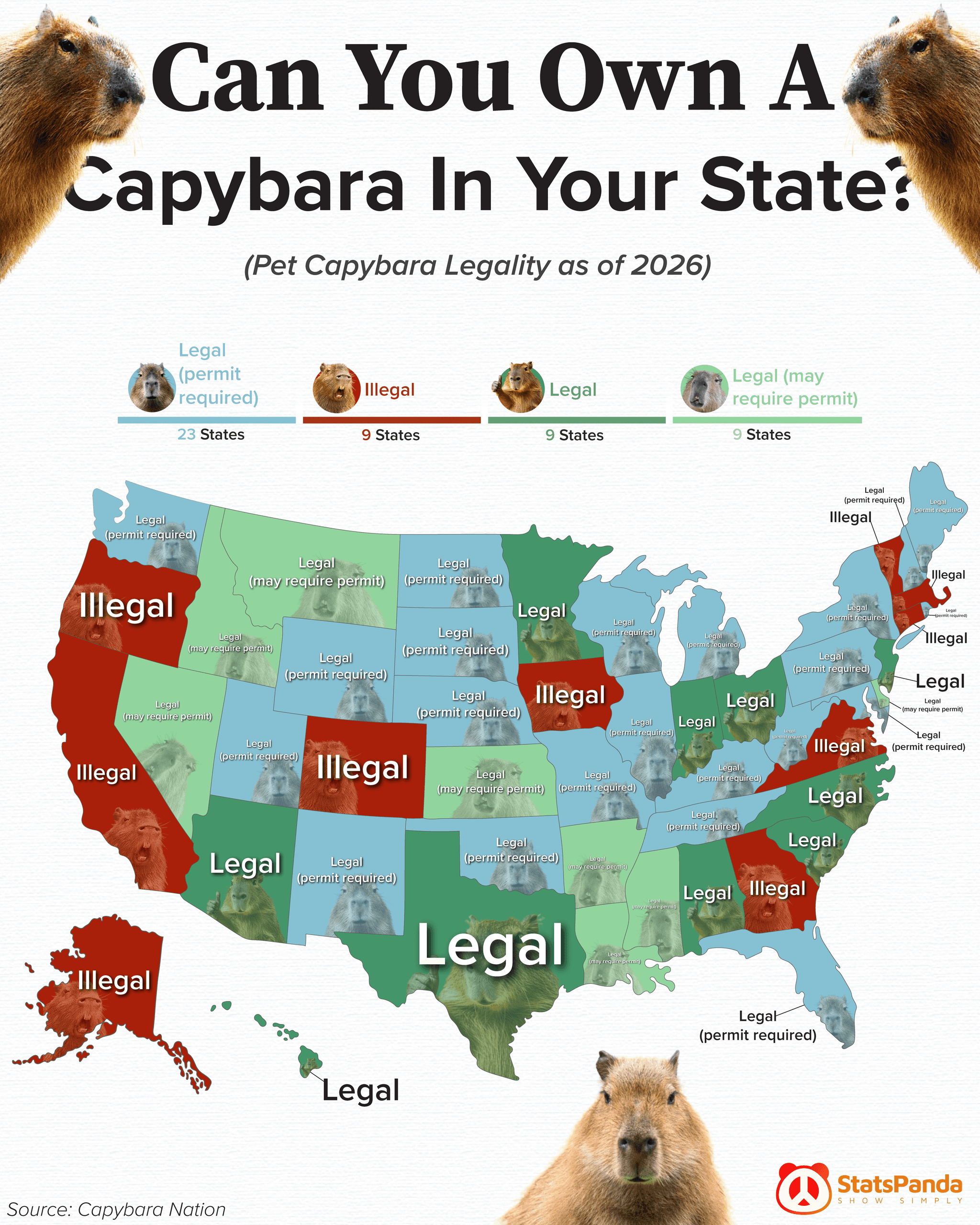
Could you, should you, and would you own a pet capybara? This map breaks down the legal status of capybara ownership across all 50 states, from fully legal to completely illegal.
The Data
This map represents the legal status of capybara ownership across the United States as of 2026, with data sourced primarily from Capybara Nation. State regulations fall into four categories: fully legal, legal with a permit required, legal but may require a permit, and completely illegal. The legal landscape is shaped by each state's wildlife regulations, exotic animal ownership laws, and how capybaras are classified—whether as exotic pets, livestock, or wild animals.
| State | Legal Status |
|---|---|
| Alabama | Legal |
| Arizona | Legal |
| Hawaii | Legal |
| Minnesota | Legal |
| New Jersey | Legal |
| North Carolina | Legal |
| Ohio | Legal |
| South Carolina | Legal |
| Texas | Legal |
| Arkansas | Legal (may require permit) |
| Delaware | Legal (may require permit) |
| Idaho | Legal (may require permit) |
| Iowa | Legal (may require permit) |
| Kansas | Legal (may require permit) |
| Louisiana | Legal (may require permit) |
| Mississippi | Legal (may require permit) |
| Montana | Legal (may require permit) |
| Nevada | Legal (may require permit) |
| Florida | Legal (permit required) |
| Indiana | Legal (permit required) |
| Kentucky | Legal (permit required) |
| Maine | Legal (permit required) |
| Maryland | Legal (permit required) |
| Michigan | Legal (permit required) |
| Missouri | Legal (permit required) |
| Nebraska | Legal (permit required) |
| New Hampshire | Legal (permit required) |
| New Mexico | Legal (permit required) |
| New York | Legal (permit required) |
| North Dakota | Legal (permit required) |
| Oklahoma | Legal (permit required) |
| Pennsylvania | Legal (permit required) |
| Rhode Island | Legal (permit required) |
| South Dakota | Legal (permit required) |
| Tennessee | Legal (permit required) |
| Utah | Legal (permit required) |
| Virginia | Legal (permit required) |
| Washington | Legal (permit required) |
| West Virginia | Legal (permit required) |
| Wisconsin | Legal (permit required) |
| Wyoming | Legal (permit required) |
| Alaska | Illegal |
| California | Illegal |
| Colorado | Illegal |
| Connecticut | Illegal |
| Georgia | Illegal |
| Illinois | Illegal |
| Massachusetts | Illegal |
| Oregon | Illegal |
| Vermont | Illegal |
Key Findings
Most states allow it—with paperwork. The dominance of permit-required categories (32 states total) demonstrates the regulatory middle ground most states have adopted, balancing individual ownership rights with concerns about proper animal care, public safety, and potential ecological impacts from escaped or released animals.
No clear geographic pattern. The regulatory framework shows significant regional variation. Fully legal states include Texas in the South, Arizona in the Southwest, Ohio in the Midwest, and New Jersey in the Northeast. Similarly, the states where capybaras are illegal are scattered across the country—from Alaska and Oregon in the West to Connecticut and Vermont in the East.
Texas leads the way. True to its reputation for permissive animal ownership laws, Texas is one of only 9 states where you can own a capybara with no permit required. The state's minimal exotic animal regulations make it one of the most popular states for capybara owners.
California says no. California doesn't allow any non-native wild animal to be a pet unless otherwise instructed by the Department of Fish and Wildlife. Capybaras—and even gerbils—don't make the cut.
What It Takes to Own a Capybara
Even in states where capybaras are legal, ownership is far from simple. Here's what prospective owners should know:
- They're the world's largest rodent — Capybaras can grow up to 140 pounds, looking like a supersized guinea pig with webbed feet
- They need water — As semi-aquatic animals, capybaras require access to water for swimming and submerging. They can swim for hours and stay underwater for up to five minutes
- No chlorine pools — They can't tolerate chlorinated water but can enjoy saltwater pools
- High-protein diet — Their diet needs to sustain their large frame with high protein intake
- Social animals — Capybaras are highly social and typically do best with companionship, meaning owning just one can lead to behavioral issues
- Licensing costs add up — Beyond the purchase price, permits through Fish and Wildlife departments or third-party processors can be expensive
States Where Capybaras Are Illegal
Nine states have outright bans or effectively make it impossible to own a capybara:
- Alaska — The Department of Fish & Game maintains a "Clean List" of approved species. If it's not on the list, it's banned
- California — Prohibits all non-native wild animals as pets unless specifically approved by the Department of Fish and Wildlife
- Colorado — Only animals deemed safe by the Division of Wildlife are allowed; capybaras don't make the list
- Connecticut — Bans the import and possession of all wildlife across four categories, including rodents
- Georgia — The Department of Natural Resources explicitly lists capybaras as an exotic species that may not be held as pets
- Illinois — The Department of Natural Resources has broad authority to prohibit possession of wild mammals, making it virtually impossible to own a capybara privately
- Massachusetts — Permits are technically required but are never issued for animals intended to be pets
- Oregon — Capybaras appear on the state's "Prohibited Species" list by name
- Vermont — Unless you are a bona fide scientific or educational facility, the Commissioner does not provide permits for wild animals
Important Caveats
Even in states that permit capybaras at the state level, county or municipal restrictions may exist. New York is a prime example—while the state allows capybaras with a permit, New York City's Department of Health and Mental Hygiene actively issues violations for keeping wild or illegal animals. Prospective owners should always confirm legality with local officials before adopting.
The permitting process in some states can be so extensive and complicated that ownership becomes practically impossible, even where it's technically legal. Owners should check with their local county or municipal councils and state Fish and Wildlife departments for the most current regulations.
Methodology
Data compiled from Capybara Nation, state wildlife agency regulations, and the World Population Review's legal database. Capybara ownership legality is categorized into four frameworks: fully legal (no permit needed), legal with permit required, legal but may require permit (varies by locality), and illegal. Data current as of 2026. Note that local county and municipal regulations may impose additional restrictions beyond state-level laws.
Sources
- Capybara Nation
- World Population Review
- State Wildlife Agencies
- AZ Animals